Thursday

Decoding Diptychs with Mori Insinger

The concept of Duality has intrigued physicists, mathematicians, economists and even common-man since time immemorial. Interpretations of people may be radically different but in simple terms duality is about interchangeability of subject's role/form/shape/behavior based on interpretation of an external unbiased observer. Whenever we see an artwork, an illustration, a photograph or a design-we usually process the information in its entirety and base our interpretation of artwork on colors we see, positive and negative spaces we observe, proximity of objects (esp. in photographs) we judge and mood the artwork elicits etc.

A while ago, while browsing my ART journal, I came across the word DUALITY (I had scribbled it many times on the same page!) and I was instantly reminded of talk by Mori Insinger, a Boston-based fine art photographer, at the Danforth Museum on 31-OCT-2009. I logged onto the artist's website, downloaded the photograph and once again found Mori's work mystical and very engaging. I decided to connect with Mori via the web to understand this series of photographs (Mori refers to them as DIPTYCHS) and relate it with what I've learned about ART so far.

Diptychs are dual-frame images that emphasize not just the elements in the photographs but even the space surrounding them. Mori writes:
  • "The Diptych Format is a way of consciously showing the context of a setting as much as the central 'subject' itself".
  • "The implicit boundaries and inherent grooming within a setting are part of an aesthetic which speaks to how inhabitants within an environment present themselves unto others."
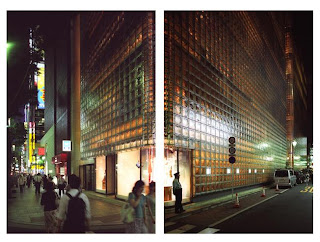
Based upon my conversation with Mori, here's a brief summary this specific Diptych, which I found simply fascinating:

  • Setting: The images for the diptych "Ginza District, Tokyo, Japan" featuring an upper-class fashion boutique, were made on a late summer evening in 2006 and the print was made in 2007.
  • Balance: On one hand bright lights, subtle feeling emanated by glass, concrete, stone, and asphalt gives this Diptych a tangible & tough look. On the other hand transparency of the building and amalgamation of bright & dark colors gives it a warm inviting tone.
  • Perspective: Eyes are drawn towards the diagonal lines emerging from center on either side and a sense of depth is developed right away.
  • Contrast: Image on the left of the boutique shows the street buzzing with people and activity as against the serene lifeless image on the right hand side.
  • Relationship: The image as a whole makes the viewer ascertain and evaluate the nature of relationship between organic (people) and inorganic (building, lights) elements.
  • Aesthetics: Fashion Boutique, the central element in the Diptych, together with distinctive boxed glass windows, concealed lighting and surrounding void space gives a sense of style and aspirations of upper-class fashion enthusiasts.
  • Energy: This Diptych certainly has a profound visual energy, which results in instant analysis process by the viewer (What's going on here?)

In our tightly packed suburbs and cities, it can be difficult to spot the 'beautiful subjects' that live in our midst and perhaps that's why most of us escape to far flung places when we take vacations hoping to break away from our otherwise fast-paced complex lives. But the moment we realize that we share cities with several other elements - animals, museums, playgrounds, shopping malls, schools and churches etc. and that we have an important role to play in this grand ecosystem of life, we start developing a deeper connection with nature, with fellow human beings and with our environment. In that respect, Diptychs are just the right messengers and reinforce the fact that our environment is much more than a simple combination of the tangible things we've acquired (vehicle, house, music player) and we can learn to become a part of this beautiful, complex, and exciting world once we start observing aesthetic subjects in our immediate environment!

While you are on Mori's website (spc. aspiring photographers)-do check out Mori's other impressive projects (Landscapes and Panoramas) too. His ability to capture vibrant colors, unseen objects and put them all together to create visually inspiring photos is extraordinarily inspiring indeed!

"What is important to my work is the individual picture. I photograph stories on assignment, and of course they have to be put together coherently. But what matters most is that each picture stands on its own, with its own place and feeling."Steve McCurry

[Images Courtesy-© Mori Insinger, Dedon]

Bookmark and Share

Sunday

Embrace Life...


What an incredible visual way to convey to communicate a simple yet powerful message of "SAFETY FIRST". Sheer genius indeed !
"The world is but a canvas to the imagination."~Henry David Thoreau

Celebrating Love!

Valentines Day can be so much fun! Like Christmas, it seems to offer just the right opportunity to step away from our busy lives and express our sincere affection towards people we value most in our lives-our parents, our siblings, our cousins, our friends and those who exhibit positive vibes and encourage us to become better individuals year after year.

We did a small exercise in Ashland, MA this Saturday - the idea was to create a mini-clip of max 15 sec duration to convey the essence of Valentines Day. We were simply amazed at the clips participants (mostly kids) came up with! Interesting thing to note though was the profound use of flowers (sunflowers, lotuses and roses), hearts, green leaves and vibrant colored butterflies. With no formal ART training, kids naturally seem to associate LOVE with nature's beautiful creations and with bright colors-I wonder how or why? But yes-it was just amazing to be amongst kids, who usually stay curious, bold, cheerful and sporting, yet again!

{VDay - 2010}
As you set out to celebrate Valentines Day in your own special way, for a moment disconnect yourself from your problems/worries and bond with the individual(s) you are with, give him/her/them your 100% attention and if possible perform some selfless act of kindness just for fun! Believe me you'll remember it up until next Valentines day :) And if you intend on staying home and spend Feb 14th as just another normal day, check out some cool websites centred around deep human bonding and love-Lovelines, Wefeelfine, Team Love and FreeHugsCampign etc.

Happy Valentines Day :)
"Good works are links that form a chain of love."~Mother Teresa

[Image Courtesy-© Lovelines]

Saturday

Going Solo...

Ever since I came to Framingham and attended a guided tour at Danforth Museum of Art, I was keen on giving a tour myself perhaps sometime in Winters of 2010. Looks like the opportunity came well in advance :) I was supposed to shadow a tour today but owing to some last minute changes, I learned that I am supposed to conduct a Public Tour solo! Now, being excited about ART or reading ART books is one thing, doing a public tour is an entirely different experience. You don't know about your audience's background, you have near zero idea of how much time viewers would like to spend listening to you, their moods or state of minds, their expectations from museum etc-there are just too many variables in the process, which can impede a new docent's enthusiasm and confidence in more than one ways :D

Anyways at sharp 1 PM, as the tour commenced, I took the viewers into (my fav) Morgan Bulkeley gallery and after brief introductions started probing visitors with questions. The VTS style worked yet again and within 5-7 mins I could feel a personal connection with the viewers, which simplified conducting rest of the tour. We discussed what artworks can tell us about people, lifestyles and beliefs from various times and cultures. We shared a common concern with our modern day consumeristic culture, which seems to be a visible impediment in our collective progress towards living a happier, healthier and adventurous life.

The tour lasted for about an hour and we covered works by Morgan Bulkeley, Gerry Bergstein and David Arinson in the hour long tour. In retrospect, I'd say I had a great time, learned so much more about the artworks I've seen almost 20 times by now, exchanged some great ideas and carried with myself a bagful of pleasant memories for the days to come.

For the benefit of those of you who haven't visited us yet, in short here's a quick snapshot on our Public Tours:
  • Danforth Museum offers docent led public tours on first-weekend of every month.
  • Museum admission is FREE with Museums On Us™
  • Our tours are full of surprises and we try hard to meet expectations of our visitors.
  • Public tours stress critical thinking, observation skills, and creative evaluation through close examination and discussion of artworks from our permanent and rotating exhibits.
  • Our museum is handicapped accessibleand we give extra attention to special needs of our visitors.

Hope to meet some of you in person at the museum soon :)

The voice of the intellect is a soft one, but it does not rest until it has gained a hearing.~Sigmund Freud

[Image Courtesy-© FraminghamNavigator]

Wednesday

Learning can be...

simplified and made fun - not always though :-)

Whenever I see the documentation that comes alongwith Enterprise Software Products, I always wonder why do companies create an impression that understanding of their products is such an uphill task? This is how the standard learning life-cycle goes when one sets out to learn a new software tool or product:


  • You download all the whitepapers and documentation about this cool new software product (DB Security Tool, DWH Reporting Tool, Analytics Tool etc)
  • You open one of the PDFs and find the Index extending to first 10-12 pages. Using the Index Section and sub-sections hyperlinks, one can locate information read fast,which is cool indeed.
  • You finally make your way to the content only to be presented with tons of verbiage and references to other sections in the PDF or sometimes references to other PDFs too :(
  • You spend some time trying to navigate elegantly through the PDF and couple of minutes later you declare that it's better to learn the tool by experimentation rather than going through this seemingly infinite documentation.
  • As you experiment, you make some notes, some illustrations and once you gain a firm grip on this new tool/technology, you realize that it wasn't rocket science afterall!

    And then you wonder why do some folks/companies create this "Illusion of Complexity" rather than coming up with creative ways to enhance the learning process!

    During our weekly docent meeting at Danforth today, we were presented with a quick walkthrough into "Sculpting Process" during presentation on Meta Vaux Warrick Fuller-the multi-talented African American artist, we were shown the sculpting tools-brushes, rubber, casting, mallot etc and a visual demonstration (Thanks Julia!) on how sculpting works. In less than 10 minutes we could understand not just the basic sculpting process but we could relate it to Meta Fuller's biograhy and work we read earlier too. This reinforces my views about "Visual Thinking". I strongly believe that under right circumstances, our brains can absorb so much more information visually and quickly when compared to the conventional "Read and Understand" style of learning.

    To illustrate a quick example, think about how best you can explain a scientific process say "Photosynthesis" to a person from a totally non-science background. I found several descriptions about "Photosynthesis" for example...

    • Photosynthesis consists of light reactions and dark reactions. This process can be simplified in this equation: 6CO2+12H2O + Light Energy → C6H12O6 + 6O2 + 6H2O.(Source ~ Biology Online)
    • The conversion of light energy into chemical energy in cells that contain chlorophyll, a green pigment. Photosynthesis occurs in most plants and algae and in some bacteria and protozoans. The process is also called carbon fixation......(Source ~ Howstuffworks)
    • In green plants, light energy is captured by chlorophyll in the chloroplasts of the leaves and used to convert water, carbon dioxide, and minerals into oxygen and energy-rich organic compounds (simple and complex sugars) that are the basis of both plant and animal life. Photosynthesis consists of a number of photochemical and enzymatic reactions. It occurs in two stages..... (Source ~ Britannica)

    Now take a look at the image above or this demo and see for yourself the simple practice of using pictures to understand Photosynthesis! Oh and if you like visual thinking take a look at this visual primer on The Art Of Complex Problem Solving.

    "Simplicity is the ultimate sophistication."~Leonardo da Vinci
    [Image Courtesy-© Factmonster]

    Sunday

    The Other Side Of Light !

    [Guided Tour @ Danforth on 01/23/2010 - With HRCA group]

    Sometimes experience turns out to be a far better teacher than theoretical reading (books, journals, white papers, news or voluminous technical manuals). I learned sometime back that at Danforth Museum Of Art, new docents are encouraged to "shadow" few tours before venturing out to lead real tours at the museum. With no prior experience of so-called "shadowing", the term conjured up vivid visuals in my mind-images of high-school optics classes, physics experiments with light sources & concave/convex lenses, esoteric definitions of diffraction/dispersion/interference etc. and of course the Greek symbol λ. I loved filling in my U-CLIPS notebooks with Greek symbols in various forms-rotated 30°or 45° wrt horizontal plane, within ultra thin left hand margins, or inside hexagonal benzene rings! Unfortunately back then our physics teacher gave more importance to how quickly we could solve cool optics numericals than how nicely we could draw λ and thus my fondness with Greek symbols didn't last long :D

    Back to present time, this "shadowing" exercise turned out to be yet another enriching learning experience for me. In short this is how it works:
    • Shadow Docents report to the Lead Docent around 30 mins prior to a tour.
    • Lead Docent explains the tour strategy / guidelines to the new docents.
    • A quick discussion on background of viewers is done prior to the tour.
    • Following a strict time-line before and during the tour is very essential.
    • Shadow Docent is supposed to pay close attention to tour, viewers' responses, touring style of lead docent and identify any specific areas of improvements (if any).
    As I followed Doreen (Lead Docent) into the galleries, she gave a quick refresher on Jewish Culture and History, described evolution of art & religion in Jewish community across the globe. When I analyzed my notes this morning, I was amazed to learn that there are so many striking similarities between Jewish and Indian Cultures! Some common traits I found cool are: Utmost respect for elders, cohesive bonding with family, appreciation of Visual Arts & Music, logical interpretations for religious rituals and communal problem solving etc.

    Our visitors from HRCA (Hebrew Rehabilitation Center For Aged) arrived at 13:30 hrs EST. After exchanging quick pleasantries with the group, Doreen took us all into David Aronson's Gallery and commenced the tour with Aronson's "Adam" & "Eve" artworks. Next we moved on to see "The Judges" and "The Paradox". Fast Forward 30 minutes...as Doreen sailed our group towards the 8-foot tall ace masterpiece titled "Resurrection, 1944", all viewers seemed pleasantly engaged within moments of viewing this gigantic artwork. It was fascinating to see everyone in the group participating actively, asking specific questions, appreciating orange, blues & greens in the artwork, deriving quick analogies with biblical charcaters and finding figurative meanings etc.

    [Guided Tour @ Danforth - Marriage at Cana by David Aronson]

    Next we moved on to see Aronson's "Marriage at Cana" artwork and this time Doreen began the tour with our museum's VTS Style and connection with audience was almost immediate. Together with enthusiatic Doreen, all of us truly enjoyed hunting down interesting objects in the artwork. Impromptu doses of light humor by Janis & Ellie (fellow shadow docents) as we stood before this artwork made the exercise even more fun!During the last 30 mins of the tour, we walked through gallieries exhbits by Garry Bergstein and Morgan Bulkley.

    Like all other good things, our tour ended around 1500 EST. As we bid good-bye to amazing team from HRCA, we thanked them for visiting Danforth and for being a group passionate in thinking and youthful at heart! We hope to see more people from HRCA at Danforth in the days to come.

    If you like works by Boston Expressionists, check out this video by Metrowest featuring Katherine French, who talks about David Aronson's artworks.

    "It takes a very long time to become young." Pablo Picasso

    Thursday

    2009 Redux...

    Today at Michael's I observed two teenagers quite invested in a heated conversation as they waited for their turn in the checkout line. The discussion was about LIMITS and CONSTRAINTS that prevent budding artists, cartoonists or sculptors to pursue ART as a full-time career. Thanks to the journal I was carrying in my backpack, I listened attentively, took some notes & thought about doing a rational analysis later. Here are salient points of the conversation I heard:

    • In kindergarten we always spot few kids who exhibit creative abilities and would make great artists if given the right education. But as these artistic kids leave kindergarten and start chasing the usual goals of getting a job, means of road transport and may be a house or two, that childhood passion for ART usually eventually takes a backseat.
    • ART Concepts can be applied almost everywhere-but society doesn't give much weightage to it since immediate returns (tangible and monetary) are not visible.
    • And then there are always so many constraints (Lack of concrete goals, supportive environment and guidance) that it just doesn't seem logical to even think about investing time in studying and understanding art!

    and so on.....

    The conversation sure wasn't of the type that would give you positive vibes; but it reminded of a similar kind of chit-chat I had with one of the members of Fablevision team during their Open House event in Oct 2009. In retrospect, I was amazed to see Fablevision Studios, meet Peter's energetic team and I was 100% convinced of the fact that limitations actually drive (and not impede) creative thinking. In short here's what I learned after talking to Peter and Bob that day (What a splendid evening it was!):


    • Given fewer resources, we are forced to focus and thus make quick and better decisions.
    • Given limited time, we learn to distinguish between what is important and what is not.
    • Given the limits, we perceive the fine line between applying ourselves to ONE key task sincerely instead of overworking ourselves with dozens of tasks.
    • Given the right team/environment, we tend to think out-of-the-box, come up with radical ideas, visualize happy endings and attain seemingly impossible goals in no time.

    But yes like everything else in life, the key is to START! As you set out to finally write those tough resolutions/goals down in your journals, blogs, diaries or sketchbooks, take a quick look at Peter's 5Bs poster-you might find it helpful and outright cool!

    A L E R T -Extend your helping hand towards HAITI natives; some avenues are-a, b, c and d

    “Life is like a ten speed bicycle. Most of us have gears we never use.”~Charles M Schulz
    [Image Courtesy-© Peter H Reynolds]

    Monday

    To Every Action...

    there is an equal and opposite reaction" - said Sir Isaac Newton several years ago. In simple terms this translates to saying that forces always act in pairs. (If an object X exerts a force say F on an object Y, then the object Y exerts an equal and opposite force -F on X provided both X and Y are involved). Some practical examples are:
    • Swimming - While swimming you push water backwards (Action) and water in turns pushes you fwd (Reaction).
    • Jet Engine - Burning fuel produces hot exhaust gases which are made to flow out from back of the jet (Action). A resulting thrust is produced in opposite direction and pushes it forwards (Reaction).

    Newton's Third Law was a stunning insight that eventually led to significant scientific research pertaining to universal law of gravitation and astronomy. Genuine artlovers have said time and again that the best artworks seem to exert a compelling force (Action) on the viewers. What's interesting to watch is how these artlovers respond (Reaction) to this force in accordance with Newton's 3rd Law! Some pursue art as a career, some try to relate art concepts in their jobs/lives and some even become artists (after years of diligent practice though) themselves. That quick science refresher was for my acquaintances who strongly believe that-crude logic, scientific facts and technology govern our lives and drive this world as against creative thinking and imagination :D

    I visited Danforth yesterday evening and I ended up filing my journal with 3-4 ideas yet again. I've observed that the more I allow myself to interact with artworks, the more interesting ART gets. Here's I think why:

    • Focus: When you walk into an art gallery, you zone out all noise sources (internet, phone, news, road traffic, verbal interactions etc) and give your 100% attention to analyzing artwork.
    • Transformation: A painting or a sculpture or a portrait transforms an otherwise void gallery space into something important, meaningful and sometimes influential too.
    • Visual Energy: Like 3-5 aged kindergarten kids (Their inquisitiveness, candidness and willingness to learn is just amazing), some artworks invite your attention right away.
    • Emotions: Artworks evoke both logical (This artist's earlier work was far better!, This looks pricy!, Why is this painting here?, It is irregular or it is quite unsymmetric!) as well as emotional responses (Woooow!, Ahaaa!, I see!, Ewwwww!, Mindblowing!, Oh my God!, Hummmm!) in the viewer.
    • Rhythm: There's always a mystical compositional rhythm in artworks. It could mean variance in thickness or thinness of the brushstrokes for some, strong straight lines or delicate curved lines for others, excessive use of warm or cool colors and so on.
    • Impressions: Colors in artworks register deep impressions in our minds and usually have an immediate effect on viewer's mood and energy levels.
    • Taste: Art also offers viewers an amazing opportunity to find "alone-time" to nurture their brains, to build critical thinking skills and to develop fine taste in human inventiveness.

    Here's a quick exercise (esp. for my friends in software/business world)...

    Next time when you spot a majestic sculpture centred in your favorite shopping mall, library or casino or you see this beautiful glass painting as you walk from Terminal A to Terminal B (or C/D/E -choice is entirely yours ;)) to catch your connecting flight-pause for a minute-see if you find something appealing or stimulating or mysterious, ask yourself "What's going on here?", "What could be the underlying message painter is trying to convey?", "How do you feel when you this artwork?" etc. Trust me it feels better than analyzing those stock prices, server response time graphs on Monday mornings or reading those news alerts with not-so-good statistics about terrorism, global warming, unemployment etc

    In case you do feel amazed and wish to relive the experience on a larger scale in a climate controlled and conducive environment-you know who to call or where to go next :) By the way-my best wishes to Uncle Newton on his 367th birthday :D

    “Art is the most intense mode of individualism that the world has known”~Oscar Wilde

    [Image Courtesy-© Vladimir]

    Friday

    Make a Wish...


    There something innocently magical about Fireworks especially the ones that light up the sky on New Year's Eve! Apart from inducing a near instant hope, cheer and happiness, they instantly push people into a "Wish Making Mode". For few seconds one's mind seems to shift into a fluid like state that invokes one's deep rooted ambitions, goals and desires. As the time goes by, some of these wishes come true (Woo-Hoo!), some stay as wishes (tougher goals) and the rest just fade away (That's ok too!) but almost all of them provoke an inward reflection. It's hard to describe the wish-making experience in words but in the long run it can do wonders indeed!

    In everyday life, most of us formulate complex plans with hundreds of sub-tasks for our respective projects/goals, use cool software tools to organize our tasks and this seems to work just fine. But I have serious doubts whether artists, photographers, sculptors do the same? As 2010 sets in, I hope (Or should I say I wish ;)) to connect to many more dwellers of ART community, try to map out their goal-setting and creative-thinking process and share the same right here...

    Oh and yes, next time you see someone (kids are great examples) doing any of the following...
    • About to close eyes before the first star in a clear night sky.
    • About to toss a coin in a river, fountain, pond or well.
    • About to blow a stray eyelash off one's fingertip.
    • Standing before a birthday cake ready to blow the lit candles.
    • Ready to blow all seeds from a white puffy dandelion in one breath.

    .....take a moment to see and understand "What's going on?', concentrate on your deepest desires, close your eyes, visualize the end result & go make that wish. Believe me - sometimes this spellbinding exercise turns out to be a memorable experience in itself. And when your wishes come true, do this drill again :D

    "The object of art is not to reproduce reality, but to create a reality of the same intensity'~Alberto Giacometti

    [Image Courtesy-© Tiqatequila]

    Wednesday

    Magical Moments...!

    Amidst this wave of excitement for 2010's countdown, I wonder what happens when you juxtrapose visual artists, sculpture artists, best pyrotechnicians, ace composers, dancing neon lights, pulsating sound tracks and of course high-spirited people? A friend from India sent me a link to First Night 2010, and I am so glad he did so :) First Night events seem a great medium to participate and celebrate creative communal spirit and richness of Boston's cultural landscape.
    As I head out to Boston tomorrow to seek pure inspiration, I hope to meet interesting people adorning those trendy FN buttons (they are still available at Shaws!), exchange some radical ideas, watch the parade, take snaps of ice-sculptures and join other turbo-charged folks in countdown to 2010 at Copley Square.

    Meanwhile my best wishes to everyone for a fantastic year ahead. A year full of hope, tremendous success (both on personal and professional fronts), uninhibited love and those magical "Ahaaaa!" moments!

    "Reason is powerless in the expression of Love"~Rumi
    [Image Courtesy-© Ekua Holmes]